
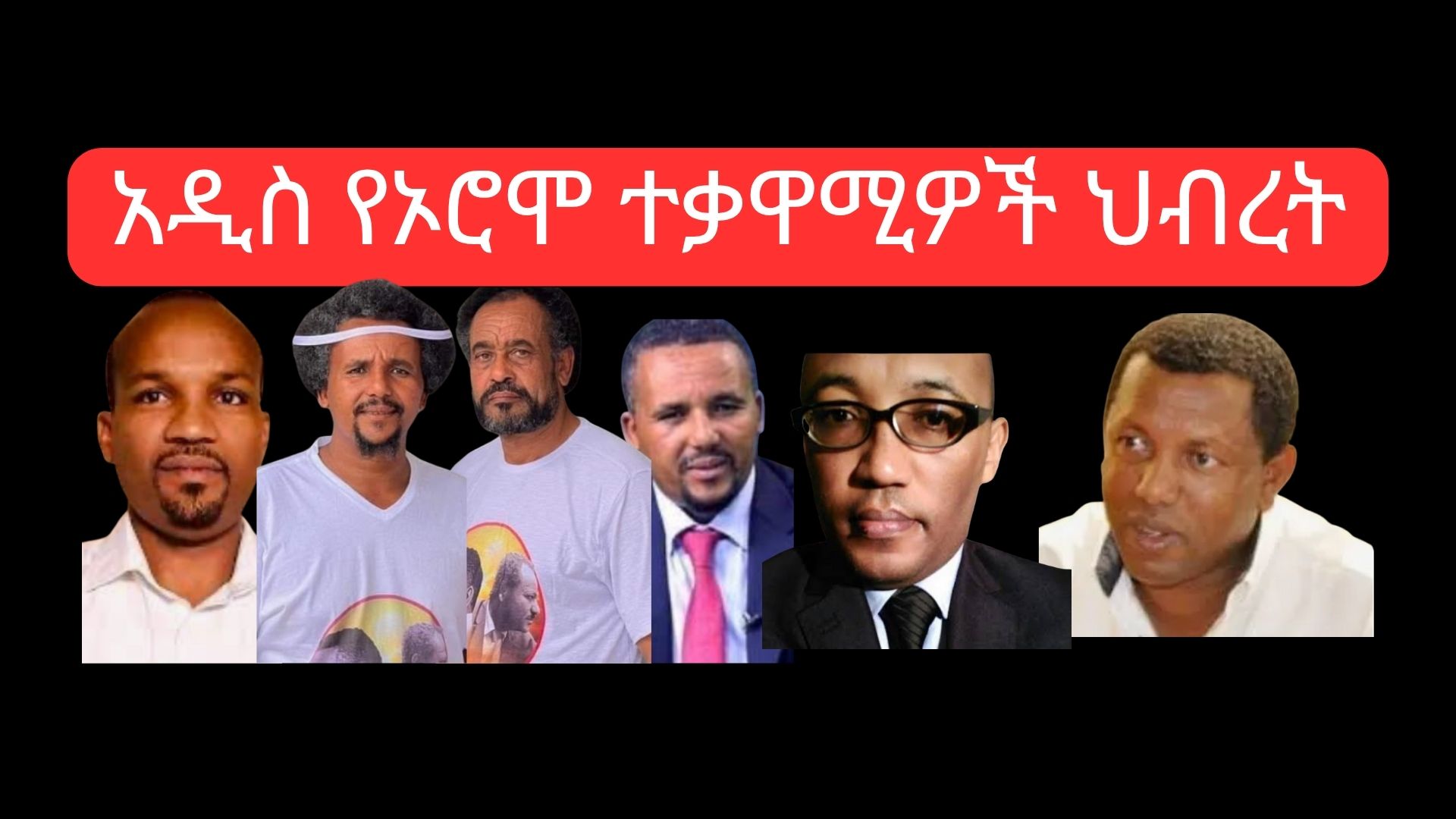
A new political alliance has recently been formed within the Oromo opposition, most of whom are currently in the diaspora. The stated objective of this alliance is clear: to remove Prime Minister Abiy Ahmed from power — a leader who himself hails from the Oromo ethnic group. Despite the ruling party being led by an Oromo figure, this development reveals a growing rift between the central government and key segments of the Oromo politicians , particularly those ideologically opposed to the regime.
The formation of this alliance, spearheaded by opposition figures based abroad, has sparked many questions regarding its potential impact on the country’s political landscape. Given that all leading members of the alliance reside in the diaspora, one must ask:
• How much of a political threat does this alliance pose to Dr. Abiy Ahmed’s government?
• Are they a well-organized and united front, or merely a loose coalition lacking a clear direction?

These questions are essential to understanding the nature and credibility of the alliance. What kind of connection exists between the people inside Oromia and the exiled opposition figures?
An in-depth analysis is also needed to examine the kind of strategies and tactics they intend to pursue:
• Do they plan to defeat Dr. Abiy Ahmed through electoral means?
• Do they intend to use force or armed struggle to overthrow him?
• Are they preparing a mass popular uprising to topple the government?
• Do they aim for a military coup or an armed seizure of power?
Furthermore, how do they plan to remove Dr. Abiy’s government and establish a transitional authority?
On the other hand, what are the key challenges and opportunities they face in order to achieve their stated goals?
In this piece, we will conduct a brief analysis addressing key questions to assess whether this newly formed alliance has the potential to succeed or whether it is likely to collapse in the end.
To begin with, one of the main reasons for the formation of the alliance — as stated by its founders — is the belief that Prime Minister Abiy Ahmed has failed to fulfill the political interests of the Oromo people. As a result, they claim they will now guide the Oromo people on what the political situation should look like after Abiy Ahmed.
Opportunities available to the opposition:
• The ongoing economic crisis and widespread insecurity across the country
• The presence of armed movements such as Fano and OLA, which are actively engaged in armed struggle
• The internal conflict between Abiy Ahmed and the TPLF, despite their recent peace agreement
• The strategic and diplomatic challenges Ethiopia faces due to major projects like the oil and gas ventures and the Grand Ethiopian Renaissance Dam (GERD)
Furthermore, Abiy Ahmed’s long-term ambition for Ethiopia to gain access to a seaport has created new geopolitical tensions. That ambition has, for the first time, aligned the positions of Egypt, Eritrea, Djibouti, and Somalia — all of whom now appear united against Ethiopia’s maritime aspirations. Key Challenges
The Ethiopian public — particularly the Oromo population — largely views the current government of Prime Minister Abiy Ahmed as the first administration that truly represents them. For this reason, many believe that despite any mistakes Dr. Abiy may have made, his leadership is still a divine opportunity. There is a deep-seated fear that if this chance slips away, they may never regain it — especially if power returns to the traditional ruling elite of Abyssinia, particularly the Amhara.
A significant number of Oromos believe that Abiy Ahmed’s government has brought enormous development and created golden opportunities that have transformed their livelihoods. They often point to the infrastructure and development seen in Oromia and, most notably, in Addis Ababa, where many people were relocated as part of a controversial urban development plan. While some critics view this plan as having hidden motives, many Oromos consider it a sign of progress.
One of the major challenges facing the opposition is their lack of unity around a shared national vision, purpose, or political ideology. For instance:
• Jawaar Mohammed, a leading Oromo opposition figure, has publicly stated that his struggle is exclusively for Oromo interests.
• Similarly, Simegne Kasaye, an Amhara opposition leader, claims to fight solely for the Amhara cause.
• And Dr. Debretsion, leader of the TPLF, is committed primarily to Tigrayan interests.
This fragmented landscape — lacking a unifying political project or credible alternative leadership — makes it nearly impossible for the opposition to build national consensus or present a viable replacement. Both the Ethiopian people and Western governments are aware of this reality. As a result, they are unlikely to support plans that lack clarity, carry high risk, or threaten the territorial integrity of Ethiopia.
To be clear: this is not to say that no segment of the population is suffering under Abiy Ahmed’s rule, nor that Western governments have any special loyalty to him. Rather, the point is that in the absence of a democratic, coherent, and nationally inclusive alternative, the international community may withhold its support for this newly formed opposition alliance.
A historical example worth recalling is from 1991, when the United States blocked the TPLF from entering Addis Ababa in a way that could have led to the destruction of the city. History repeated itself when TDF forces approached Addis Ababa again in recent years, only to be stopped short due to similar geopolitical concerns.
It is extremely unlikely that the opposition can win through elections and then go on to form a new government. It is no longer possible for Jawar Mohammed to mobilize and inspire the youth of Qeerroo and the Oromo public as he once did, particularly as was seen during the downfall of the TPLF-led government. Therefore, it is very difficult for the opposition to organize or spark a unified mass uprising.
When we consider the possibility of an armed struggle through groups like OLA and Fano, this too appears highly challenging — primarily because there is no realistic scenario in which OLA, Fano, and TDF could align politically.
While Egypt’s strategic plans — executed through Eritrea, which has both military experience and long-standing ties with Ethiopian opposition groups — should not be underestimated, even that coordination recently resulted only in a secret agreement with TPLF.
The possibility of an internal military coup to remove Prime Minister Abiy Ahmed remains extremely weak.
Another significant obstacle is the strength of Ethiopia’s national security institutions, particularly the national army,

All of these challenges stem from one core issue: the diaspora-led opposition is unwilling to personally sacrifice for the mission of removing dr Abiy Ahmed from power. And without leadership, no uprising has ever succeeded.
Conclusion:
Based on the above information and additional insights, I firmly believe that although the new Oromo opposition alliance, along with the existing Amhara and Tigrayan opposition movements — and external adversaries like Egypt and Eritrea, who see this moment as a golden opportunity to derail both the Grand Renaissance Dam and Ethiopia’s seaport ambitions — may indeed have a serious impact on Ethiopia’s security and stability, I do not believe they are capable of successfully removing Prime Minister Abiy Ahmed from power.


Leave a Reply